Qriton HLMAI decisions you can inspect, trust, and replay
For high-stakes structured data, prediction alone is not enough. HLM exposes the decision path: uncertainty, evidence, convergence state, and records that can be inspected later.


For high-stakes structured data, prediction alone is not enough. HLM exposes the decision path: uncertainty, evidence, convergence state, and records that can be inspected later.
Six entry points. Pick the one that matches what you need to know.
Transformer systems usually specialize by modality: separate vision stacks, audio stacks, multimodal bridges, and alignment layers. HLM separates the problem differently. Frontends preserve each input's geometry; the shared polynomial Hopfield core performs associative refinement.
Language, images, audio, 3D, and sensor streams do not have to pretend to be the same data. They enter through matched frontends, then meet in a common energy-landscape substrate that can expose convergence, uncertainty, and editable basins.
This is the direction of a world model: stable concepts grounded across modalities, not only patterns inside a sequence.
Training is still the right tool for broad capability. It is the wrong tool for every localized update: a policy, a known pattern, a refusal style, or a represented concept. Qriton HLM adds a second control surface: basin surgery.
Energy Language operates on the basins that HLM can locate, compare, and test. The goal is not to hide model change inside another training run; it is to make the change explicit.
Energy Language "Energy minima as a programming language in a completely new fashion." John J. Hopfield, March 2026, on programming energy landscapes directly
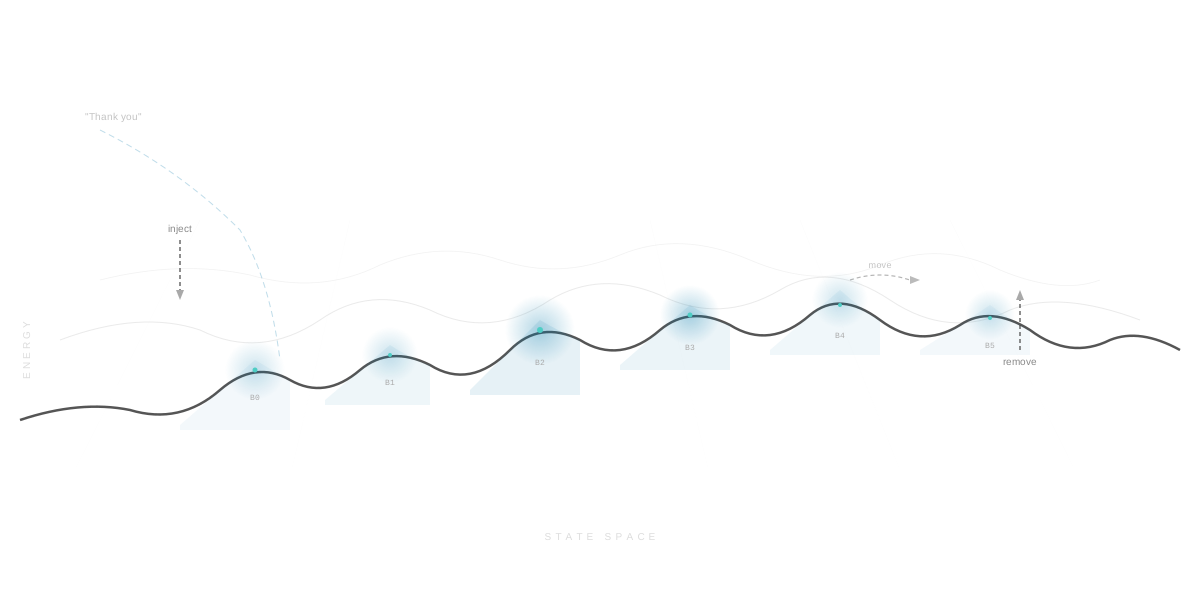
A small interaction shows the shape: capture a concept, inject it into a layer, apply the operation, and test the resulting behavior.
The full language includes landscape inspection, basin modification, semantic concepts, causal checks, guards, and scripts.
Explore the full language →hlm:model> capture 5 polite Thank you so much for your help Captured L5 -> concept 'polite' (1 samples) hlm:model> inject-concept 5 polite 0.1 Concept added as a new basin (+1) >> Concept successfully injected! hlm:model> apply 5 hlm:model> generate Tell me about the weather I'd be happy to share! The weather today is...
Demo checkpoints are available for language, vision, audio, and edge tiers. For early access, custom training, or pilot projects in high-stakes workflows — get in touch.
We're also open to research collaborations with universities and institutions working on energy-based models, associative memory, interpretability, or multimodal architectures. If you're exploring related directions, we'd like to hear from you.