Qriton HLMBuild controllable AI systems on Hopfield memory
For early adopters, data scientists, academic labs, startups, and enterprise teams developing the next generation of inspectable, editable, and auditable AI.


For early adopters, data scientists, academic labs, startups, and enterprise teams developing the next generation of inspectable, editable, and auditable AI.
The portal is built for teams evaluating HLM as a real platform: read the docs, run demos, inspect checkpoints, test Energy Language workflows, and decide where controllable AI fits your roadmap.
The portal is organized around practical adoption paths. Pick the track closest to your work, then move from concept to demo to model artifact without changing context.
Developer docs and demos require approved early access. The public home page and request form stay open.
HLM keeps modality-specific frontends at the edge of the system, then routes representations into a shared polynomial Hopfield core. The practical goal is controllability: model states you can inspect, uncertainty you can measure, basins you can edit, and decisions you can replay.
For data scientists and engineering teams, this means the same inspection surface can show up across language, image, audio, 3D, and sensor workloads. For researchers, it exposes a concrete substrate for studying memory, convergence, and interventions. For startups and enterprise pilots, it creates a path toward AI behavior that can be tested and governed.
The docs focus on those operational surfaces: model loading, inspection, basin surgery, validation, deployment patterns, and audit records.
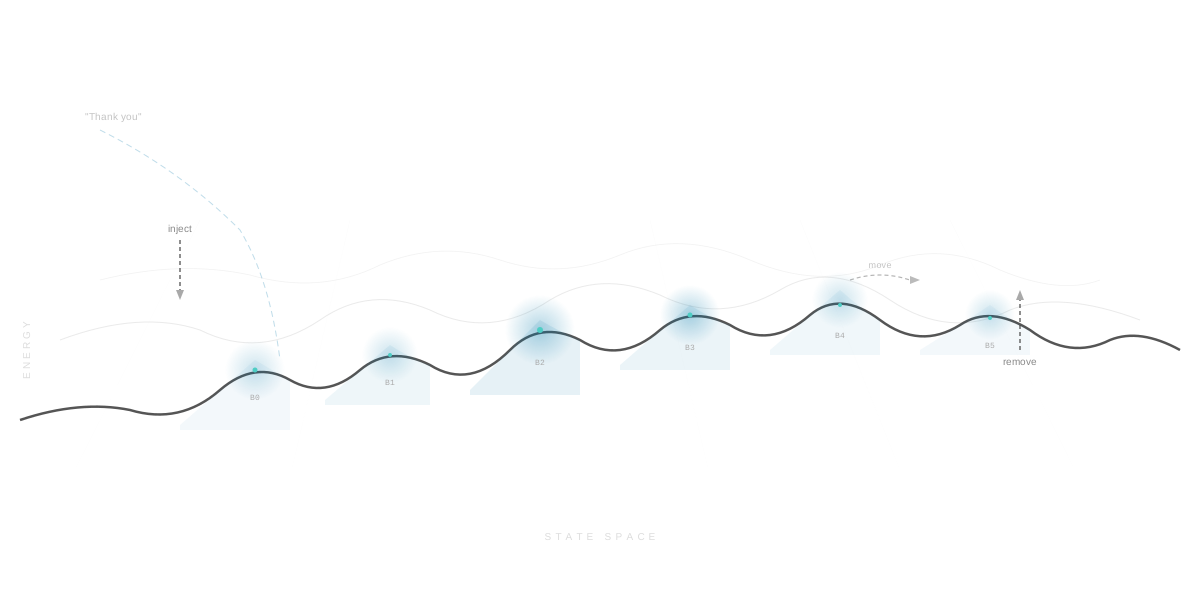
Training is still the tool for broad capability. Energy Language is the control surface for localized changes: capture a concept, inject or move a basin, apply the edit, and test the behavior.
The important property is that the change is explicit. A lab can study it, a data team can measure it, a startup can prototype with it, and an enterprise team can review, revert, and attach it to an audit trail.
Energy Language "Energy minima as a programming language in a completely new fashion." John J. Hopfield, March 2026, on programming energy landscapes directly
Start interactively, then promote stable operations into scripts. The same primitives cover landscape inspection, basin modification, semantic concepts, causal checks, and guards.
The portal includes command references and walkthroughs for testing the result after each operation, from research notebooks to pilot workflows.
Request access to the docs ->hlm:model> capture 5 polite Thank you so much for your help Captured L5 -> concept 'polite' (1 samples) hlm:model> inject-concept 5 polite 0.1 Concept added as a new basin (+1) >> Concept successfully injected! hlm:model> apply 5 hlm:model> generate Tell me about the weather I'd be happy to share! The weather today is...
The Model Zoo is the place to check what is available, what changed, and where the limits are. Early-access members get the first validated checkpoints and the notes needed for research, product evaluation, and pilot planning.
Compact tiers for edge sensing and on-device inference. Current releases include efficiency-tuned checkpoints with lower iteration counts and reduced weight footprint.
Language models focused on inspectable decision paths, uncertainty gating, and replayable audit records.
Image and spatial frontends feeding the shared Hopfield core, with the same inspection and audit surfaces.
Audio-stream frontends for monitoring and diagnostics where each decision needs supporting trace data.
Early-access members are notified by email as each checkpoint becomes available. See the Model Zoo for what is released today.
If you are an early adopter, data scientist, academic researcher, startup founder, or enterprise team evaluating controllable AI, request access and describe the technical path you want to explore.
Approved members get the documentation, demos, model cards, release notes, and Energy Language references needed for serious evaluation.